Social Media poses an existential threat to our relationship with horses
Recent incidents that have exploded on social media so much so that they have caught the attention of mainstream media and have been reported on in several newspapers around the world, highlight the threat to the relationship between humans and horses.
A few thousand years ago, humans domesticated the horse, and a successful partnership between our species has existed ever since. Our co-existence with horses is not an equal or democratic partnership. The success of our existence with horses, from the earliest domestication of the horse for use in agriculture, mining, and combat, right up to today’s primary use in sport and recreation, is predicated on there being a dominant partner and a subservient one in the relationship. It is the key to the success of the partnership. Without it, the partnership could not exist. Without it, the horse poses a danger to both itself and the person. Pretending we share equal authority is absurd. Accepting that we have different roles in the partnership is not the same as asserting that both roles are not equally important. In the same way, recognising that it is a partnership is not the same as suggesting it is a democratic partnership of equal rights and responsibilities.
When the horse is anthropomorphised in the partnership, the partnership ceases to be one with dominant and subservient roles as it goes against our modern belief in the fairness and equality of all human individuals. With this anthropomorphisation, the human is unfairly attempting to confer all manner of rights and obligations on the horse that it has absolutely no mechanisms with which to cope with the resulting demands. With rights come accountability and responsibility. Horses simply have no way to be accountable or responsible, therefore they cannot have the same rights as the human in the partnership. It is unfair on the horse in the extreme to behave like they do have the same rights and responsibilities.
We cannot apply the same standards and expectations of behaviour to horses as we do to humans, and it is folly to even try to. Whether we like it or not, we are not the same.
As a result, when we deal with horses in whatever situation, be it riding, competing, a farrier visit, a veterinary inspection, loading onto a vehicle, grooming or simply walking the horse to the paddock, as humans, and as the dominant partner in the relationship, we have to accept the responsibility that we are in charge. At ALL times. Though it may comfort us to kiss and cuddle the horse, and even the fact that we can kiss and cuddle the horse, does not alter anything about the fundamentals of our relationship. We remain unequal partners. As humans, we remain in charge and responsible.
When the horse is required to stand obediently for the farrier or the vet., it is the human’s responsibility that he does so. When the horse is expected and required to lead safely in traffic, or load quickly and quietly onto a truck on the side of a road, it is the human’s responsibility that the horse obliges. It is never the horse’s responsibility. As humans, we discharge our responsibility to the horse by gaining sufficient knowledge, skill and understanding for us to train the horse to be respectful and obedient in every anticipated situation. It is not possible to allow the horse the right to decide in which situations he should be compliant and accept the human’s demands, and those other situations where he can ignore the human. The horse simply does not have the understanding and resources at his disposal to make those decisions, and expecting him to do so is extremely unfair. Accordingly, our partnership with the horse is dependent on the compliance and obedience on the part of the horse at all times.
In order for our partnership with horses to exist and to thrive, it is incumbent on the human partner that any demands or requests made of the horse are both fair and reasonable, taking into account all the circumstances of any given situation. If in the circumstances, the requests and demands are fair and reasonable, then the human has a responsibility to ensure that the horse complies with those expectations. Any abdication of this responsibility is potentially damaging to the partnership, as it introduces doubt and uncertainty. The horse must trust and believe 100% in the fairness and reasonableness of the human’s decisions and demands, or its behaviour and then the outcomes start to become unpredictable. Unpredictable outcomes can place both human and horse in dangerous situations.
During the course of training the horse, there are inevitable incidents where some level of coercion is required to establish and maintain the horse’s acceptance of the human’s dominance. Coercion, rather than persuasion, is occasionally necessary because of the nature of the communication tools available between our two species and the limitations of the horse’s intellect. We cannot rationalise with the horse which would afford us the ability to persuade rather than coerce. Amongst horses themselves, an element of their communication is achieved through coercion, and a degree of coercion is a concept which the horse understands. As humans, we have had to accept that a certain level of coercion is a necessary part of our relationship.
When we anthropomorphise the horse, this coercion offends our human sensibilities of fairness and equality. In the idealised world of our imagination, any use of force or coercion is somehow never acceptable. But the mere fact that our human sensibilities have been offended, does not in anyway relieve us of our responsibility. From time to time, and in certain situations, some coercion is necessary, no matter how unpleasant or uncomfortable that may make us feel. If we are unable to accept that sometimes we have to stop being the ‘nice human’ and use some limited, but necessary force, then we need to be brave enough to accept that we have no right to continue our partnership with the horse. At that point we no longer have any basis for that relationship as we have abdicated our responsibilities.
As the use of horses in sport and recreation has grown, so too has the inevitability that less experienced, knowledgable and skilled humans are involved with horses than in years past. Similarly, the emergence of social media has exposed the use of horses in sport and recreation to a vast audience that has very little to no knowledge, skills or experience with horses. The nature of social media is such that an absence of knowledge, skill or experience is no barrier to having an opinion that is just as influential as the opinion of someone who is knowledgable, skilled and experienced. As a result, social media has become disproportionately filled with the opinions of the unknowledgable, unskilled and inexperienced. Disastrously, these unknowledgable, unskilled and inexperienced opinions are now shaping the decisions of the governing bodies of those that oversee horse sports and recreation. Fearful of sponsors’ perceptions, and the economic repercussions of losing sponsors, governing bodies are pressured into accepting the influences and pressures of those that are least knowledgable, skilled and experienced. Bowing to these pressures may well appear to achieve appeasement of the unknowledgable, unskilled and inexperienced on social media. Sponsors may well be placated, but in reality, this appeasement will only be a temporary respite, because this approach fails to address the elephant in the room which is that our relationship with the horse is based on accepting that we are dominant in that partnership. The partnership requires human leadership and responsibility. It is a fact that cannot be ignored or altered to suit the opinions of those unknowledgable, unskilled and inexperienced.
Recent incidents that have exploded on social media so much so that they have caught the attention of mainstream media and have been reported on in several newspapers around the world, highlight the threat to the relationship between humans and horses.
The incident of the Pony Club mother who appeared to ‘slap and kick’ a horse, captured on video and shared across social media, resulted in her global humiliation and vilification, ousted from and condemned by her local Hunt and the Pony Club. In reality, and on the evidence of the footage on which she was condemned, what the woman did was nothing more than discipline the pony, avoid a potentially dangerous traffic incident and load the pony on the lorry. The whole incident lasted 27 seconds from start to finish, and whilst not pretty to watch, her ‘slap and kick’ resulted in an apparently uncooperative pony immediately walking quietly, obediently and without fuss onto the lorry. Her actions were decisive and prevented further unpredictable consequences. As far as the slap and the kick go – absolutely they don’t look ‘attractive’, but I have no doubt the only lasting effect they had on the pony was to establish in the pony’s mind that the woman was in charge, knew what she was doing and should be obeyed. At critical times, such as when loading horses on a public road, that decisive leadership is what is necessary, and that necessity doesn’t change simply because social media exists.
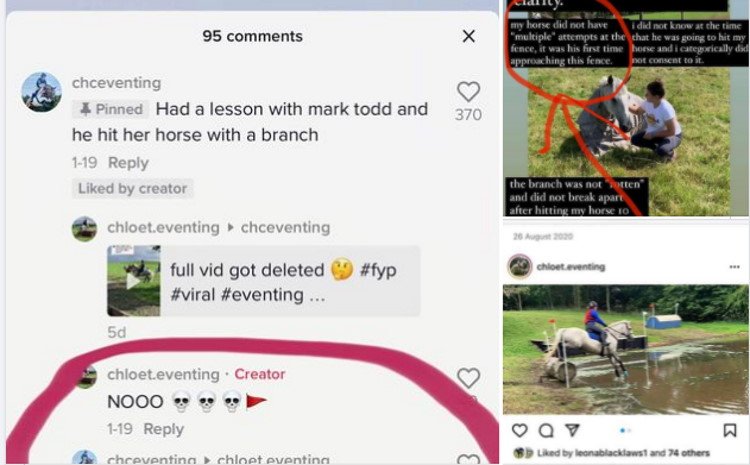
More recently, video of Mark Todd giving x-country instruction has come under the scrutiny of social media and the mainstream newspapers. Mark Todd’s credentials as an experienced, knowledgable and skilled horseman are probably unsurpassed in the world of equestrian sport. Yet, once again, he has been vilified and condemned on social media as well as suspended by professional bodies. Again, on the basis of the video footage that led to the social media ‘outrage’, it is clear that Mark Todd is applying the coercion that he, an expert, deemed necessary to encourage the horse to do that which he believed was a perfectly fair and reasonable request. Throughout the incident Mark Todd appeared calm, rational and decisive. There was no loss of temper and no hint of frustration, only a firmness and conviction that he believed that his request of the horse was reasonable and fair.
Once again, there is no denying the horse was coerced into obedience by a half a dozen strikes on the rump with a convenient stick off of a branch on the ground. Similarly, whilst the incident was not pretty to watch, it was decisive and effective. No doubt the horse felt the sting of the stick, but I am equally sure the horse has felt more discomfort from the bites and kicks of other horses out in the paddocks. The only lasting effect it may have had on the horse was to make the horse less inclined to question reasonable requests from the rider in the future.
In both these cases, and in others like them, the capitulation demonstrated of the governing bodies by condemning the individuals involved has not appeased the unknowledgeable, unskilled and inexperienced voices on social media. Far from it, it has catastrophically contributed to re-affirming those ill-informed opinions and undermined the foundation that forms the basis of the relationship between humans and horses. The voice of ill-informed opinion will only grow louder. Rather than surrender for the sake of short term financial gain, these governing bodies need to show strong leadership and conviction. They need to accept that recreational and sporting equestrian activities cannot have mass appeal unless they are prepared to stand by their community and be honest with everyone else about the nature of the relationship that exists between humans and horses.